Monday, 11 May 2015

Swindles, Swindells and the American Civil War

There is a database, the  Civil War Soldiers and Sailors System which contains information about the men who served in the Union and Confederate Armies during the Civil War.

The battle of Chickamauga

I have extracted the list of Swindle, Swindell etc in the database and listed them on the page  American Civil War.

A summary breakdown by name is;-

Duplicates
discounted
    All Entries
Confederacy All 194 264
Confederacy Swindle 116 152
Confederacy Swindell 35 49
Confederacy Swindall 5 8
Confederacy Swindles 0 0
Confederacy Swindel 4 5
Confederacy Swindells 6 7
Confederacy Swindler 12 14
Confederacy Swindlers 0 0
Union All 96 154
Union Swindle 20 36
Union Swindell 14 22
Union Swindall 0 0
Union Swindles 3 9
Union Swindel 3 5
Union Swindells 12 16
Union Swindler 31 38
Union Swindlers 0 0

It will be seen that there are twice as many 'Swindle' (etc) fighting for the Confederacy as for the Union - or five times as many if the 'Swindlers' are excluded.

There were about 250 Swindle s fighting in the war. Considering that the death rate was around 25% it suggests that around 60 died in the war. For many there is no record of their death except their disappearance from the census.

In the First World War the death rate among the UK forces was around 12%.

More about the Swindell Surname

Wednesday, 22 April 2015

Essential references

There are two books which reside just behind my right shoulder for easy access.

They are only relevant to UK family history research.

The first is 'The Phillimore Atlas and Index of Parish Registers' edited by Cecil R. Humphrey-Smith published by Phillimore & Co Ltd in 1995 ISBN 0850339502. (maps and index to parishes). There is a newer 3rd edition of this in 2002.

The second is the 'Bartholomew Gazeteer of Britain', compiled by Oliver Mason, published by John Bartholomew and Son ltd 1977 ISBN 085152771. (maps and gazeteer). The only reservation is that it does not include Ireland.

Despite the offerings of Google and Family Search I would not be without these two books for the visual context they provide for any place name search. If you can find them, buy them!

More about the Swindell Surname


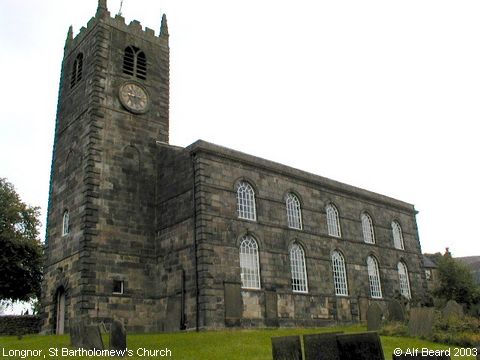
St Bartholomew's, Longnor, Staffordshire

No tidy, joined up stories for this post, I'm afraid. Much more typical of the realities of one-name studies. However I am noting my thought processes.

Back in early March Georgina Hutber sent me some more transcripts of Swindell (etc) entries from the registers of St Bartholomew's, Longnor, Staffordshire. I am especially grateful for these since these registers appear nowhere on line except on FreeReg from 1795 onwards. In due course they should appear on FindMyPast as part of the digitisation of the Staffordshire registers but I have no idea as to when. This is a good example of where the Bishop's Transcripts supplement the Parish Registers and vice-versa. I have entered these additions, as well as her original information, on my page for Longnor registers.

The Church of St Bartholomew, Longnor

St Bartholomew, Longnor, was a chapelry in Alstonefield parish - in Staffordshire but on the Derbyshire border. There was a church at Longnor apparently by the 12th century and certainly by the earlier 15th century  Between 1774 and 1781 the church was demolished and a new one built on a site to the north. The current church has a Norman font, carved with crude heads and chevrons, the only survivor from the original medieval building.
St Bartholmew's, Longnor
Quite a substantial church. In 1812 the walls were raised to allow a south gallery (which was later removed) and a west gallery; an upper arcade of windows, of similar shape to those below, was added.

Over the years Longnor overtook Alstonefield in importance but St Peter's, Alstonefield, remained the parish church and marriages were normally celebrated there until 1837. From 1753 to 1837 marriages at Longnor would have had no legal validity.

New Entries

The new entries introduce
i)    Sarah Swindall, baptised in 1691
ii)    Elizabeth, daughter of Thomas Swindell, baptised on the 7th of January 1709/10.
iii)   Elizabeth, wife of Thomas Swindle, buried on the 15th of January 1713/14
iv)  Thomas, illegitimate son of Elizabeth Swindell of Fawfieldhead, baptised on the 8th of May 1718

Note that there are still a number of unconnected entries in the Longton registers.

These new entries introduce new questions but resolve no old ones.

i)    There is a Sarah Swindal, daughter of Thomas Swindal buried in December 1728 but it is unlikely that a 37 year old spinster would be described as daughter of ... . The death is more likely to be that of an infant child of Jane, Thomas's wife who died in July of 1729. A later note by Georgina 'extinguishes' most of this record saying Sarah belongs to an earlier entry - so a birth but no name.

ii), iii)   Elizabeth, with a daughter Elizabeth, is possibly the first wife of the Thomas Swindale who died in 1745

iv)   This Thomas is probably the elder brother of Matthew (b1723) also an illegitimate son of Elizabeth Swindell. Possibly the Thomas Swindil who died in 1764.

However I will add the new individuals to my database and hope that they may resolve questions I have not yet asked!

Thomas Swindal born about 1680, died 1745

I have formed a 'mind-image' of a Thomas Swindal who appears seven times in the records of Longnor and Alstonefield but with no evidence to link any one reference to any other (eg ii) and iii) above). What follows is 'speculative fiction' joining up known facts with sheer imagination. Facts in italics.

Thomas was the younger son of Richard Swindle, who was born in 1634 in Bakewell, Derbyshire. Richard Swindle married Sarah Swindle in 1664 in Alstonefield and settled at The Ridge. Ridge Farm is 2 km south of Longnor. Richard was excommunicated in 1678. This sounds terrible but probably means he hadn't / couldn't / wouldn't pay his tithes.

Thomas settled a little further west at Fleet Farm, Fawfieldhead, almost mid-way between Longnor and Leek. He married, first, Elizabeth and had a daughter named after her mother in 1709. In 1708 Thomas was chosen as constable for Alstonefield. This office was circulated around the more well-to-do landowners/tenants  and was the parish 'policeman' and had many duties. It was not a popular job and the parishioner chosen often opted to pay someone else to act in his place. Later in his life Thomas acted in place of Richard Hadfield in 1731 and in place of Richard Bowman in 1732.
Thomas's first wife Elizabeth died in 1713. He remarried to Jane and had a daughter Sarah. Unfortunately Jane died in 1728 after the birth and her daughtet Sarah died five months later.

Thomas moved to Nabbs in Wildboarclough in Cheshire but died in 1745 and chose to be buried in Longnor beside his two wives.

His daughter Elizabeth, born in 1709, married Geoffrey Brunt in Leek, just five miles to the west, in 1731.

I have added no pictures to this part of the post because I am not certain they would be relevant.



Monday, 20 April 2015

Myfanwy

Myfanwy

One of the delights about family history nowadays is how, if you let it, the internet will entice you from one connection to another - and I believe your life is enhanced as a result.

Somewhere, in a cardboard box, I have an LP of Sir John Betjeman reading some of his own poems.

Statue of John Betjeman at St Pancras station
I can't remember whether his poem 'Myfanwy' is on that record but I can vividly imagine him reading the verse

"Smooth down the Avenue glitters the bicycle
Black-stockinged legs under navy blue serge
Home and Colonial, Star, International,
Balancing bicycle leant on the verge."
From John Betjeman "Myfanwy" published in "Old Lights for New Chancels" (1940)

(For the full poem see this link)

"You only have to look at a poem such as "Myfanwy" - one of his most emotionally naked - to feel the camera leading you effortlessly back and forth across the generations, as the grown Myfanwy bicycles "out of the shopping and into the dark, / Back down the avenue, back to the pottingshed, / Back to the house on the fringe of the park", where the adolescent Betjeman first saw and fell in love with her, playing sardines at a party. Before we reach the Fuller's angelcake we see the motherly Myfanwy once more, reading to her own children. The poem collapses the generations with such assurance. The montage of images, immediately moving, only gradually reveals its meaning as the generations extricate themselves at subsequent readings. The confusion echoes his own slight embarrassment. Is she a child or a mother? Is she a girl he once knew and lost touch with and longs for still, remembering her childhood beauty? Or just the wife of a friend? Larkin talks somewhere about the need to give the reader something to be going along with, while reserving something more to repay closer scrutiny. Betjeman manages this with cinematic blurrings of time and space."
Hugo Williams, The Guardian 2006

My "Golden Myfanwy" John Betjeman called her.

"Mary Myfanwy Evans was born on 28 March 1911 into a Welsh family in London. Her father was a chemist in Hampstead, north London. She attended North London Collegiate School, from where she won a scholarship to read English Language and Literature at St Hugh's College, Oxford.
From 1935 to 1937 she edited the periodical, Axis, devoted to abstract art. In 1937 she married the artist John Piper, with whom she lived in rural surroundings at Fawley Bottom near Henley-on-Thames for much of her life.

Between 1954 and 1973 she collaborated with the composer Benjamin Britten on several of his operas, and between 1977 and 1981 with composer Alun Hoddinott on most of his operatic works. She was a friend of the poet John Betjeman, who wrote several poems addressing her, such as "Myfanwy" and "Myfanwy at Oxford".
John and Myfanwy Piper had two sons and two daughters. Her elder son, painter Edward Piper, predeceased her.
She died at her home in Fawley Bottom on 18 January 1997"
Wikipedia

The Benjamin Britten operas for which she provided the libretto were 'The Turn of the Screw", "Owen Wingrave", and 'Death in Venice' - all powerful works. She also provided libretti for three works by Alun Hoddinot which I do not know -  'What the Old Man Does is Always Right', 'The Rajah's Diamond' and 'The Trumpet Major'. I do not know them now but I am inspired to find and listen to them.

OK - but what is the Swindell connection you may well be asking.

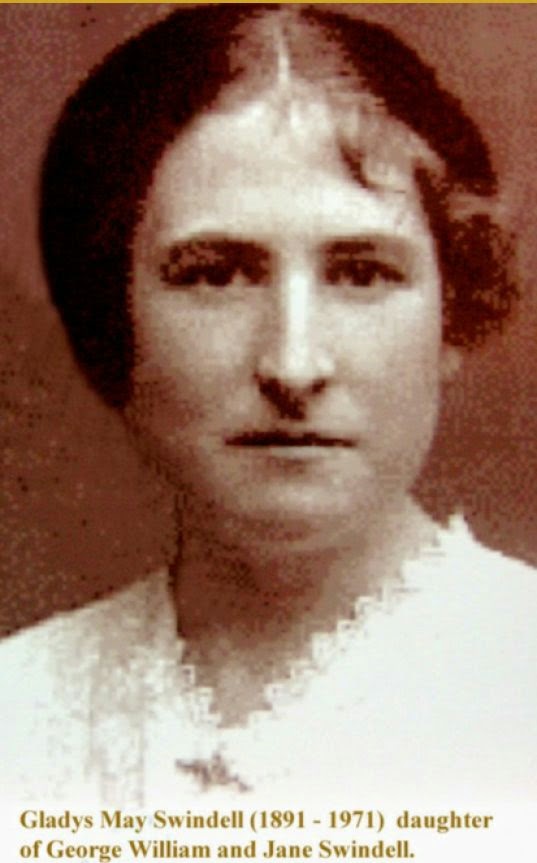
Gladys May Swindell

Courtesy of Michael Cope
Daughter of George William Swindell and Jane Macaree, born on the 5th of May 1891 at 92 Caledonian Road, Clerkenwell and the granddaughter of Thomas Swindell, born in Parwich, Derbyshire, who had become a London public house landlord. Her father had been a coal merchant but had died in 1908 when she was 17, the youngest daughter. In 1911 the six children who remained unmarried shared a house in Wood Green, north London. Gladys was a typist at Messrs Kearley and Tonge.

Four unmarried sister remained at Wood Green until at least 1929 but by 1934 had moved to Carshalton on the southern fringe of London in Surrey. Gladys never married and died in Surrey in 1969.

So what is the connection with John Betjeman?

International


In 1911 Gladys was a typist at Messrs Kearley and Tonge. The business was founded in 1878 by Hudson Kearly (later Viscount Devonport) and Gilbert Augustus Tonge as the International Tea Co., with the objective of selling tea direct to consumers rather than through wholesalers. Soon most towns in the South of England had their own International Tea Co. store as immortalised in a verse from John Betjeman's poem "Myfanwy". (see above).


'International Stores' became a chain of retail grocers - the first UK supermarket chain and one of the largest companies on the UK stock exchange. It was bought by British American Tobacco as part of their efforts to diversify away from tobacco. It was thereafter a pawn in the UK supermarket business and became part of Asda, Sainsbury and the 'Coop' (via Sommerfield).


More about the Swindell Surname

Butler and Pub Landlord

Mike Cope recently sent me details of his Swindell ancestry which traces back to Parwich in Derbyshire. One of these ancestors illustrates the move from the countryside to the town.

Thomas Swindell (1808-1872)

Thomas was the youngest son of George Swindell born in 1808 in Parwich in Derbyshire and might have been expected to become an agricultural labourer like his father. It is not known whether he went to Checkley in Staffordshire to work on his brother Samuel's farm or was attracted by the prospects for work at the Phillips' cotton mills there. However in due course he joined the domestic staff at Heybridge, the home of Robert Phillips, one of the mill owners.

In the 1841 census Thomas is a the only male servant in the large but not grand establishment of  Robert Phillips at Heybridge. The Phillips family employed 600 men, women and children in a factory in Upper Team which specialised in (cotton) tape manufacture. On Thomas's 1846 marriage certificate he describes himself as 'Butler'. In the staff in 1841 are his future bride, Mary Tuffnall, and her sister Ann. Elizabeth Ogden, at 70 possibly the housekeeper, was almost certainly the Elizabeth Ogden who was one of the witnesses at the wedding.
Heybridge in 1920, demolished in the 1950s
By 1846 he was butler but married one of the staff and as was then, I believe, normal the couple would be expected to leave domestic service.
Thomas Swindell in 1846
Mary Tufnall in 1846

He first became manager of a pub in Derby, the Woodman's Stroke and then moved down to London by 1861 to run at least three different pubs there. The last of these pubs was the Griffin in St Leonard Street, just north of Liverpool Street Station.
The Griffin, on the corner of St Leonard Street, Shoreditch
Thomas and Mary had two sons and two daughters and established a considerable family in London.

In 1871 he described himself as a 'licenced victualler - not in business' and died the following year.

Parwich

A Swindell family had settled in Parwich by at least 1642 when the first burial is recorded. Thomas's ancestry can be traced back to James Swindell of the Fold who was born about 1698 and died in 1780. I hope to research this branch of the family at some future point but for the moment I would point anyone interested to an article in Newsletter 8 of the Parwich and District Local History Society.

More about the Swindell Surname

Monday, 13 April 2015

Garibaldi biscuits and other morsels

The last two certificates that Ruth Ward sent me were the marriage certificate of Jane Ann Swindells  and John William Chadderton in 1882, together with the birth certificate of her son Garibaldi in 1886.

Garibaldi Chadderton


Garibaldi Chadderton had been named after his uncle Garibaldi Chadderton who had been born in 1861. He in his turn was undoubtedly named after the famous Italian general Giuseppe Garibaldi (1807-1882) who had just won a famous campaign in the unification of Italy.
Giuseppe Garibaldi in 1866
This campaign, and his earlier campaigns for the republicans in Italy had made Garibaldi a hero to many of the working class throughout Europe. (For more information see Wikipedia).

Garibaldi Chadderton was brought up in Oldham, Lancashire and married Deborah Hyde in 1908 in Oldham and had one son John William in Oldham before emigrating to New Zealand where he and Deborah had two more sons, Joseph and William.

(Garibaldi may have arrived aboard the Tainui on the 25th of April 1912 where a Geo. Chadderton, Iron Moulder, 25 is listed amongst the passengers.).

I do not know the date when Garibaldi enlisted but by 1917 he was listed with the New Zealand Army Reserve.
Garibaldi Chadderton (courtesy of Rick Chadderton)
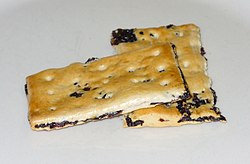
He was recalled to service to Burnham military camp during the influenza epidemic to help on the isolation wards but contracted the disease himself and died on the 1st of December 1918 in Christchurch. He was 32 years old - less than half the age achieved  by Giuseppe Garibaldi whose example had given him his name (and the name of the Garibaldi biscuit which was first manufactured by Peak Freans in 1861)
A couple of Garibaldi biscuits.

Jane Ann Swindells

Jane Ann Swindells had married John William Chadderton on the fourth of February 1882 at Coldhurst Parish Church, Oldham, Lancashire.
The copy of  Jane Ann Swindells marriage certificate

She was an illegitimate daughter as shown by her naming Emily Swindells in the space provided for the father's name and forename.

The address on the marriage certificate is the same as for herself in the 1881 census, living in Oldham with the sister-in-law of her step father Charles Matthews.

According to a family story
"At Age 16 years she is reported to have walked the 10 miles from Bramhall to Oldham for work. She stayed with her Aunty in Oldham (related through the Matthews who were the family that her Mother had married) and then married my ancestor John William Chadderton there.

Their marriage took place during their lunch-hour and then they returned to their various places of work thereafter. That sounds like a tough life.

(Actually she would have been living in Heaton Norris, not Bramhall, but the ten miles would be about right)

Jane Ann developed a thriving second hand goods business. Her husband died quite young (in 1907) so this provided for the family until her death in 1930. However, she was know for her generosity and "forgiveness" of the debts of those less fortunate from time to time.

Her own birth certificate names her as the daughter of Emma Swindells, born on the 24th of January 1862 at  9 Longshut[...] Stockport Jane Ann mother Emma Swindells registered ... March 1862.

Emily (Emma) Swindells

9, Longshut Lane is where Emma was living with her parents, Thomas and Jemima Swindells at the 1861 census. She was 18 and no doubt wrapped up in her affair that was to lead to Jane Ann's birth ten month's later . Emily married Charles Harrison Matthews in 1865 and they went on to have five children before Emily's death on the 11th of November 1883 in Heaton Norris, Stockport. 

N.B. Heaton Norris was in the Borough of Stockport which spread across the River Mersey. The centre of Stockport is on the south side of the river and in Cheshire. Heaton Norris is on the north side of the river and in Lancashire. The Mersey actually flows under the modern shopping precinct in the centre of Stockport.

Neither any baptism nor birth registration has been found for Emma. Though civil birth registration commenced on the first of July 1837 it was not compulsory until 1875. Baptism is of course voluntary (as far as the parents are concerned, not for the baby!). If both the ages in the censuses and Emily's age at death are correct then Emily would have been born between November 1842 and March 1843.

Thomas Swindells and Jemima Pott and Phoebe Haughton (née Moore)

Stockport from the west in 1819, the year of Thomas's birth

Thomas Swindells was born about 1815 in Bram(h)all, Cheshire according to the 1851 and 1861 censuses but in 1819/20 according to the 1871 census and his death registration.  He married Jemima Pott on the second of January 1837 at St Mary's Church, Cheadle. Thomas was a silk weaver in the 1841 census but silk weaving in Stockport  was in decline and in 1842 'work has never been so slack' and wages so low'. Thomas responded by becoming an agricultural labourer.

Thomas and Jemima had three daughters - Elizabeth born about 1835, Jane born 1839 but died 1842 and Emily, born about 1842/3.

Jemima died on the 12th of August 1868 and the next year Thomas married Phoebe Haughton, a widow with a teenage son. Thomas died before the 1881 census and his death is almost certainly the one registered in 1878 at the age of 59. 

At his second marriage he had named his father as 'John' and Thomas is very probably the Thomas, son of John and Mary Swindells born on the 10th of March and baptised on the 10th of May 1819 at the Hatherlow Congregation Church. Bramhall was quite a widespread township but did not have its own church or chapel. The chapel of St Chad's at Chadkirk was the nearest Established Church but for the non-conformist there was the  Unitarian Chapel at Dean Row or the Congregational Chapel at Hatherlow. The trip to the chapel would have been about two to three miles depending on where in Bramhall the Swindells lived.

It is interesting that Thomas appears to have overstated his age by five years during his marriage to Jemima. If I have his birth/baptism correct then he would have been still 17 when he married while Jemima would have been 22 or 23.

More about the Swindell Surname

Friday, 10 April 2015

Absalom Swindells c1833 - 1858, Manchester, England

Absalom - now that should be an easy name to follow up, I thought. It turned out a relatively straightforward but interesting diversion from what I was supposed to be researching.

Absalom appears to have been the illegitimate son of  Absalom Dugmore (though he names his father as Richard Swindell, a coachman on his marriage entry)  and his young servant Mary Swindles. Mary would have been only about 13 at the time if the age in the 1841 census is correct. In 1841 they were living at/in the Piazza, off Eagle Street in Manchester. Look up Piazza Manchester nowadays and you find references to Fast Food and The Big Eat.

Figure 7 - Smithfield Market in 1880, drawing by Henry Edward Tidmarsh (Manchester Archives & Local Studies). The 'Cocozza Wood' building is visible on the right, also the adjacent Burton Arms.

However Eagle Street was close to the Smithfield market (no doubt named after the London original), convenient for Absalom Dugmore who was a fruiterer.

From this background it perhaps not surprising that young Absalom soon got into trouble with the law and in 1850 he was sentenced for two offences of larceny from his employer. This betrayal of trust no doubt attracted extra punishment and he was awarded 1 month in prison for the first offence and 3 months for the second offence - to commence after completion of the first term. At the age of 16, in gaol, he described himself as a 'master pawnbroker' - no doubt tongue firmly in cheek.

No sooner out of gaol than his silver tongue got some young lady (possibly Jane Rutter) into trouble resulting in the birth of Absalom Swindell (1852-1853) - I may be maligning young Absalom since I have no proof he was the father.(I won't pay for the  birth certificate!)

In 1853 he married Jane Rutter at the church of St Mary, St Denys and St George in  Manchester ( Manchester Cathedral from 1847).

They had three children before Absalom died in 1858 -
Eliza Jane born on the 25th of September 1853, baptised on the 20th of November 1853 in Manchester Cathedral
William Henry, born on the 30th of November 1854, baptised on the 12th of April 1857 in Manchester Cathedral
Benjamin Isaac, born on the 16th of November 1856, baptised on the 12th of April 1857 in Manchester Cathedral
Benjamin died in 1858 and I can find no more about William Henry but Eliza Jane emigrated to Australia. She married Robert Blaxland in 1874 in Newcastle, New South Wales and had six known children. She married Joseph T. Richards in 1919 (presumably after Robert's death!) and died in Fairfield, New South Wales.

Jane Swindell (nee Rutter) remarried in 1859 to an Edward Lees, a Police Officer.